Our Locations ➔ Atlanta ➔ PAD Treatment

3225 Cumberland Blvd SE, Suite 520, Atlanta, GA 30339
Get directions ➔
Contact us:
Phone: (678) 208-9894
Fax: (404) 868-3363
Office Hours
Monday – Friday: 8am – 5pm
Saturday – Sunday: Closed
Georgia Endovascular's Atlanta clinic is an outpatient interventional radiology clinic at 3225 Cumberland Blvd SE, Suite 520, Atlanta, GA 30339, in the Cumberland area of northwest Atlanta, near the I-75 and I-285 interchange.
Board-certified interventional radiologists Dr. Kevin Lie and Dr. Sachin Sheth diagnose and treat peripheral artery disease (PAD) here, including leg pain with walking (claudication), poor circulation in the legs and feet, and slow-healing foot and leg wounds. Limb preservation is a focus of the practice, because Georgia and the Southeast have some of the highest amputation rates in the country.


Peripheral artery disease (PAD) happens when plaque builds up inside the arteries that carry blood to your legs and feet. This narrowing, called atherosclerosis, limits how much oxygen-rich blood reaches your leg muscles, especially when you walk.
PAD is common after age 50 and easy to mistake for normal aging. Left untreated, it can lead to wounds that won't heal and, in severe cases, amputation. It also signals a higher risk of heart attack and stroke.
The classic sign of PAD is claudication: cramping, aching, or tiredness in the calves, thighs, or hips when you walk that eases after a few minutes of rest. Other symptoms include:
Who is at risk?
Leg pain is not something you have to accept as part of getting older. Consider an evaluation if you have:
A leg or foot that suddenly turns cold, pale, numb, or severely painful can mean blood flow has been cut off. Call 911 or go to the nearest emergency room.
Your evaluation starts with a conversation about your symptoms and a check of the pulses in your legs and feet. The main screening test is the ankle-brachial index (ABI), which compares blood pressure at your ankle with blood pressure in your arm. It is quick and painless.
If the ABI is abnormal, your physician may order an ultrasound, CT angiography, or MR angiography to map exactly where an artery is narrowed.
Early PAD is often managed with medication, a walking program, and quitting tobacco. When symptoms limit your walking or a wound won't heal, your physician may recommend revascularization, which reopens the artery from the inside:
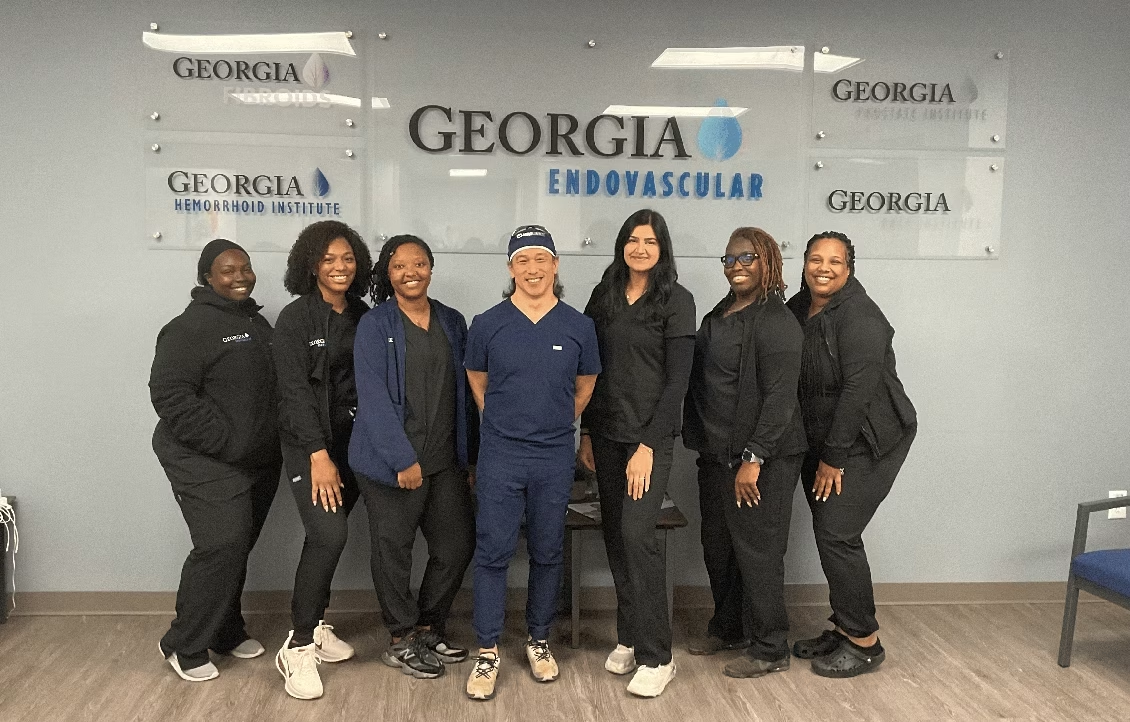

Dr. Kevin Lie and Dr. Sachin Sheth, both board-certified interventional radiologists, treat PAD at our Atlanta clinic. They see patients at all three Georgia Endovascular clinics, so ask when you call if you would like to see a specific doctor.
Our Atlanta clinic evaluates leg pain and poor circulation and offers balloon angioplasty, stenting, atherectomy, and medication management. Your physician recommends a plan after reviewing your symptoms and test results.
Peripheral artery disease is a narrowing of the arteries that carry blood to your legs and feet, usually caused by plaque buildup (atherosclerosis). Less blood reaches your legs, which can cause pain when you walk, numbness, and wounds that are slow to heal.
The most common early sign is cramping, aching, or tiredness in the calves, thighs, or hips when you walk that eases after a few minutes of rest. Other signs include a cold lower leg or foot, numbness, shiny or discolored skin, and sores on the feet or toes that won't heal. Some people have no symptoms at all.
Most PAD is confirmed with an ankle-brachial index (ABI) test, which compares blood pressure at your ankle with blood pressure in your arm. If the ABI is abnormal, an ultrasound, CT angiography, or MR angiography can show exactly where an artery is narrowed.
Yes. Severe peripheral artery disease (PAD) can restrict blood flow enough to cause nonhealing wounds, infection, and, in the most serious cases, amputation. Georgia and the Southeast have some of the highest amputation rates in the country. Early evaluation and treatment to improve blood flow can help preserve limb health and reduce the risk of complications.
Read our recent blog, How Interventional Radiology Supports PAD Limb Preservation and Prevents Amputation, for more information on treatment options and limb preservation.
Most PAD procedures are done with local numbing and light sedation, so patients feel little during treatment. The access site may be sore for a few days.
Most patients go home the same day and return to light activity within a day or two. You will need to avoid strenuous exercise and heavy lifting for a short time, and your care team will explain how to care for the puncture site.
Medicare and most major insurance plans cover PAD treatment when it is medically necessary. Our team verifies your benefits and explains what you can expect to pay before your procedure is scheduled.
Yes. Our Atlanta clinic sees PAD patients from Smyrna, Vinings, Marietta, Sandy Springs, and Buckhead, and from across Cobb County and northwest metro Atlanta. Appointments are available Monday to Friday, 8am to 5pm.
We are at 3225 Cumberland Blvd SE, Suite 520, Atlanta, GA 30339, near the I-75 and I-285 interchange. Call (678) 208-9894 for directions.
Scheduling
Please contact our dedicated specialists to schedule a consultation today.